
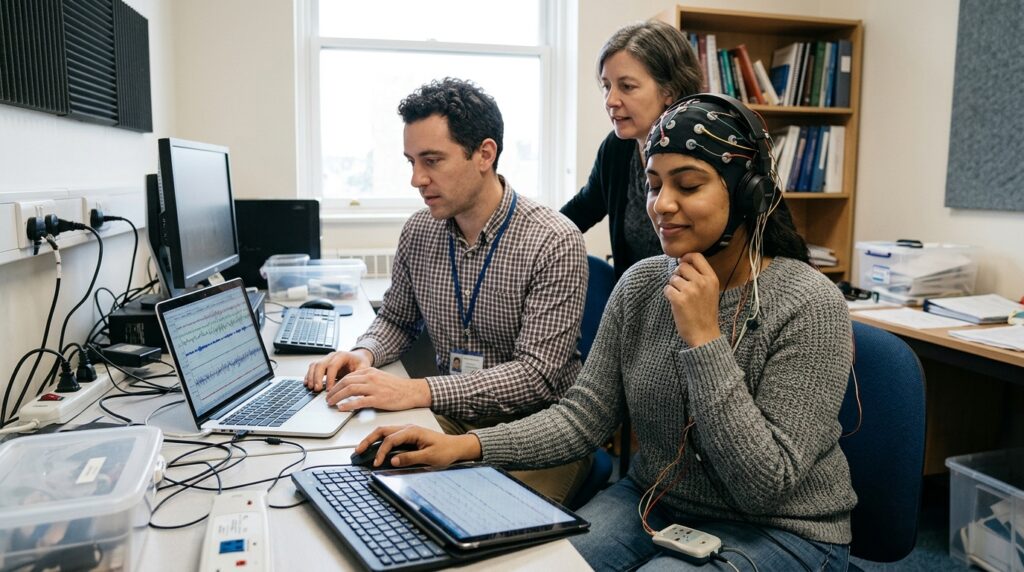
In an innovative convergence of neuroscience and artificial intelligence, researchers have designed a prototype system capable of interpreting electrical brain signals to compose music tailored directly to a listener’s feelings. Detailed in a recent paper by researcher Yanlin Zhou, the experimental setup demonstrates how neural activity can be converted into responsive auditory experiences, offering a novel pathway toward personalized psychological interventions.
Translating Neural Activity into Personalized Music
The study introduces a prototype brain-computer interface (BCI) engineered to establish a direct link between an individual’s neural activity and responsive sound generation. By tracking electroencephalogram (EEG) recordings—the minute electrical rhythms produced by firing neurons across the scalp—the system gauges an individual’s internal emotional valence. According to the study, the interface successfully reads these complex brainwave patterns to distinguish whether a person is experiencing positive, negative, or neutral feelings, setting the stage for music that adapts directly to the listener’s internal state.
High-Accuracy Emotion Detection with EEG-Conformer
At the heart of the framework lies a specialized deep learning architecture known as the EEG-Conformer. This model is designed to process both frequency bands and electrode distributions, decoding the subtle temporal and spatial cues embedded within raw neural data. When tested on the widely benchmarked SEED emotion dataset, the EEG-Conformer achieved an accuracy rate exceeding 95% in correctly identifying the user’s emotional state. Crucially, subsequent visual analyses demonstrated that the system’s high performance relied on physiologically meaningful neural patterns linked to authentic emotional processing, rather than arbitrary signal noise.
From Brainwave Classification to Music Generation
Once the system successfully identifies a user’s emotional state, it initiates an automated creative pipeline. The classification outcome is translated into a theory-guided descriptive text prompt detailing specific musical qualities. This prompt is then delivered directly to a generative artificial intelligence music engine, which synthesizes an original audio composition tuned to the classified state. By removing the need for manual inputs or self-reported feelings, the system enables an intuitive translation from neural dynamics to responsive acoustic output.
Implications for Mental Health and Therapeutic Tech
Because emotional states wield a powerful influence over physical and mental health, finding non-invasive methods to monitor and stabilize mood is a major goal in digital wellness. The researchers suggest that responsive auditory feedback could eventually offer targeted support for emotional regulation, stress relief, and mood enhancement by serving as an adaptive sonic mirror. Although the framework currently operates as an experimental prototype evaluated on existing benchmark datasets, it highlights an exciting frontier where neuroscience and generative AI converge to bolster human well-being.
Source
- Electroencephalogram (Eeg)-Conformer For Emotion Recognition And Theory-Guided Music Prompt Generation: A Prototype Brain-Computer Music Interface
- Researchers: Yanlin Zhou
- Journal: Scholarly review .
- Read the original study