
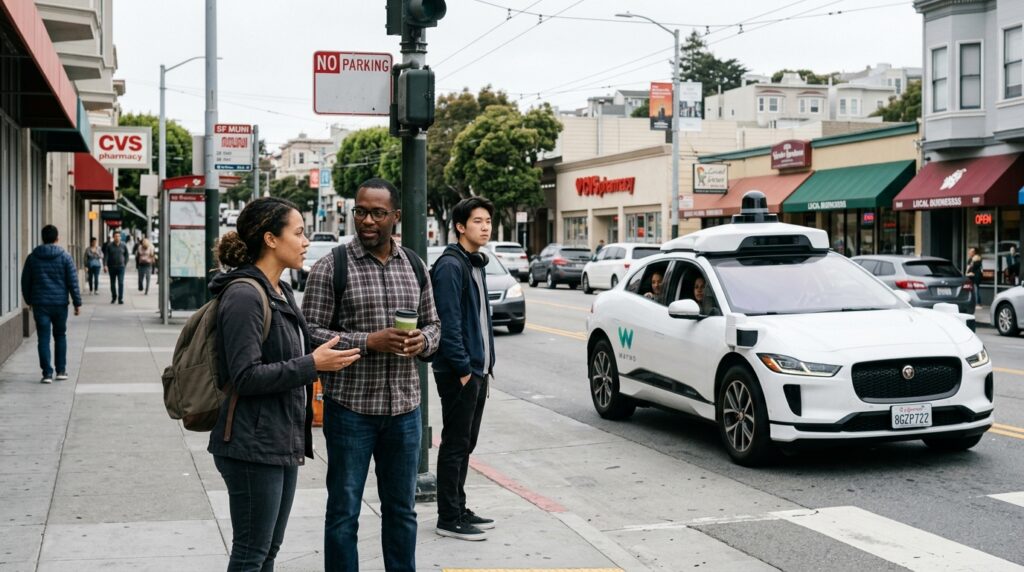
Living side by side with driverless vehicles dramatically softens public skepticism, according to a newly published study examining naturalistic interactions in California. Researchers investigating community sentiment found that residents living in one of the world’s most mature commercial deployment grounds express far greater confidence in autonomous vehicles (AVs) than the broader public, suggesting that everyday contact plays a crucial role in overcoming anxiety about automated transit.
Real-World Contact Drastically Elevates Trust
In the San Francisco Bay Area, 61% of surveyed residents reported trusting self-driving vehicles to be safe—a figure 4.7 times higher than the 13% national benchmark. While the vast majority of earlier acceptance research has relied on speculative surveys or small-scale laboratory trials with inexperienced participants, this cross-sectional study surveyed 811 individuals living amidst active commercial deployments. Conducted by researchers Carlos Guirado, SangHyouk Oum, Julia B. Griswold, and Joan Walker, the study gathered insights from 376 robotaxi passengers and 435 non-passengers, capturing psychological attitudes shaped by genuine street-level exposure rather than hypothetical scenarios.
Perceptions Diverge Inside and Outside the Vehicle
Although baseline trust across the region was remarkably high, safety perceptions varied sharply depending on how residents interacted with the vehicles. Among robotaxi passengers, trust reached 82%. In contrast, non-passengers—including pedestrians, cyclists, and conventional motorists sharing the roadway—reported trust levels between 43% and 45%.
Notably, even non-riders trusted autonomous transit at rates more than triple the national baseline. According to the study, this pattern suggests that ambient exposure alone eases skepticism. Simply observing robotaxis routinely navigating complex urban intersections without incident appears to build community familiarity, possibly operating via a subtle mere-exposure effect that normalizes the technology over time.
Technology Fears Fade, but Human Unpredictability Lingers
The researchers discovered that direct experience fundamentally recalibrates specific safety worries. Concern regarding technological or mechanical malfunction was significantly lower among robotaxi riders (45%) than among pedestrians and cyclists (63%). The authors explain that first-hand experience provides passengers with immediate performance feedback, reassuring them of the software’s reliability.
By contrast, anxieties regarding unpredictable human road behavior remained stubborn across all participant categories, hovering at approximately 55%. This divergence highlights a persistent psychological barrier: while passengers quickly learn to trust the machine’s programming, automation cannot easily resolve broader urban anxieties regarding reckless drivers, jaywalkers, or erratic traffic.
Implications for Future Urban Transit
The authors highlight an important caveat to their findings: self-selection bias cannot be completely ruled out, as technologically progressive individuals may be disproportionately inclined to live in the innovation-heavy Bay Area.
Nevertheless, the study carries practical lessons for transportation planners and AV developers preparing to roll out commercial fleets in other cities. Because public fears naturally decouple into machine competence versus human chaos, outreach strategies cannot focus solely on showcasing autonomous software. Instead, developers and urban planners must focus public communication and street design on how autonomous systems safely negotiate the messy, unpredictable human environments they are built to share.
Source
- Trust in the wild: Multi-modal safety perceptions in naturalistic AV deployment
- Researchers: Carlos Guirado, SangHyouk Oum, Julia B. Griswold, Joan Walker
- Journal: Transportation Research Part F Traffic Psychology and Behaviour
- Read the original study