
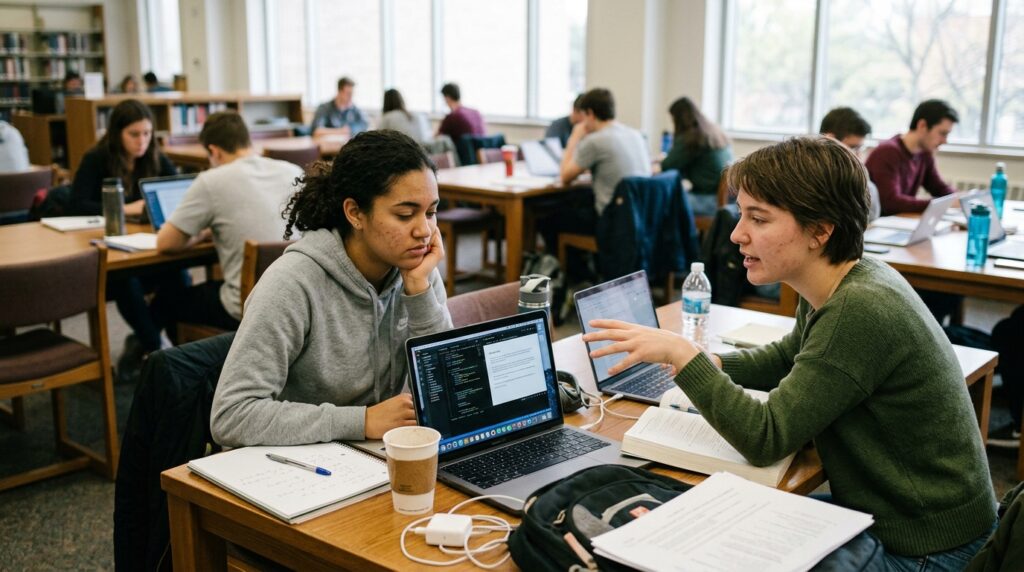
As college students increasingly embrace tools powered by generative artificial intelligence to speed through problem sets and lab reports, new psychological research warns that this convenience may come at a hidden academic price. A study published in the journal Applied Sciences reveals that heavy reliance on AI in science, technology, engineering, and mathematics (STEM) coursework can undermine deep learning by encouraging students to skip the mental exertion necessary to master challenging ideas.
The Illusion of Efficiency
While AI assistants can help students finish complex technical tasks at record speed, frequent use is associated with a distinct drop in cognitive depth. To explore this dynamic, researchers Jing Yang, Zhenqing Li, and Yoshinori Yamaguchi analyzed 326 valid responses from undergraduate STEM students, investigating how specific interaction patterns with AI shaped genuine conceptual grasp.
Applying structural equation modeling and hierarchical regression analysis, the authors identified an educational paradox: higher intensity of AI use was negatively associated with deep engagement in course material. While students may have felt efficient completing assignments rapidly, their actual grasp of fundamental scientific and mathematical concepts often remained superficial.
The Trap of Cognitive Offloading
The statistical models pinpointed cognitive offloading—the tendency to outsource mental effort to an external tool—as the underlying mechanism driving this learning loss. According to the study, offloading risk directly mediated the negative link between heavy AI usage and deep engagement.
When students reflexively turn to chatbots to generate explanations, write code, or solve equations, they frequently bypass the productive struggle central to STEM mastery. This mental effort is essential for building robust mental models. By passively accepting ready-made answers, students save time in the short term but circumvent the internal problem-solving processes that transform temporary information into lasting comprehension.
Critical Evaluation as a Cognitive Buffer
Fortunately, the researchers found that AI use does not inevitably doom higher-order learning. The negative effects largely depended on how students approached the technology. Those who engaged in deliberate critical monitoring—actively questioning, scrutinizing, and verifying AI-generated output—consistently maintained higher levels of deep engagement.
Similarly, students who practiced dialogic reconstruction, which involves iteratively refining, challenging, and rewording AI suggestions rather than accepting them at face value, were far better protected from passive shortcuts. Critical monitoring effectively weakened the association between usage intensity and cognitive offloading, acting as a crucial mental shield that kept learners cognitively involved even when interacting with automated systems.
Rethinking AI in Higher Education
The study highlights an urgent challenge for university STEM educators: distinguishing between AI-assisted performance and authentic, independently developed competence. A polished homework submission no longer proves that a student has internalized the mechanics behind the solution.
Rather than banning these technologies, the authors urge universities to explicitly instruct students on how to engage with them constructively. STEM curricula must teach learners to treat generative AI as an intellectual sparring partner or sounding board rather than an answer machine, preserving independent critical thinking while preparing them for a technology-driven workforce.
Source
- Critical Monitoring and Cognitive Offloading in GenAI-Mediated STEM Learning: A Moderated Mediation Model of Deep Engagement
- Researchers: Jing Yang, Zhenqing Li, Yoshinori Yamaguchi
- Journal: Applied Sciences
- Read the original study