
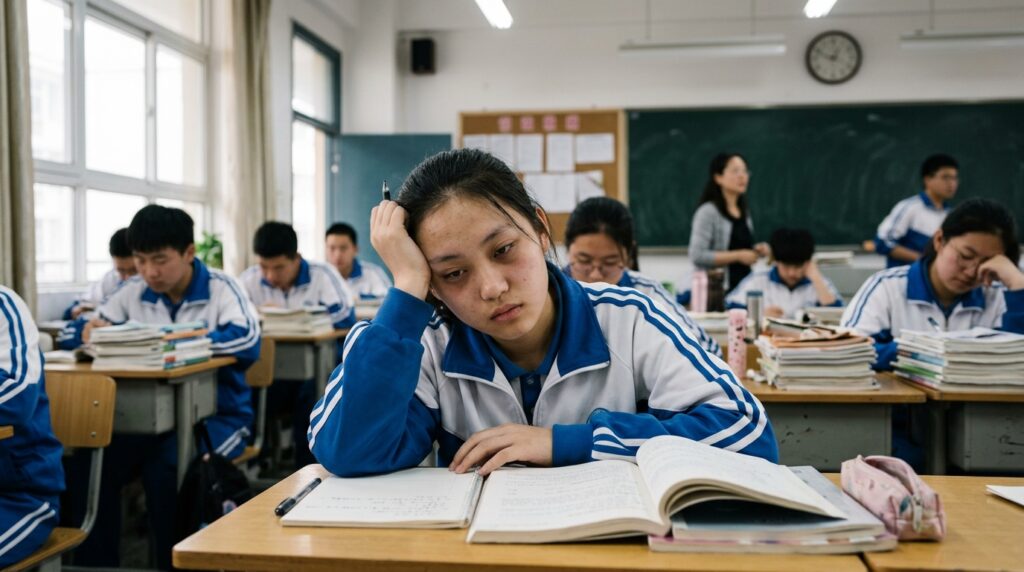
Returning to the classroom has long been viewed as a vital antidote to pandemic-era isolation, but new findings suggest that the traditional school desk may carry its own heavy emotional burdens. A study published in Frontiers in Pediatrics reveals that secondary school students attending in-person classes reported notably higher levels of psychological distress and depressive symptoms than those learning remotely from home, with poor sleep quality further intensifying adolescent struggles.
Surprising Disparities Between Classroom and Home
In a large survey assessing youth well-being, researchers uncovered an unexpected pattern: in-school learning was linked to significantly greater psychological distress and depressive symptoms compared to home-based online learning. While remote instruction during the COVID-19 pandemic raised widespread concerns about social isolation and academic disruption, the data indicate that physical school environments brought substantial emotional pressures of their own.
Overall, the mental health burden among participants was pronounced. Nearly one in four students—23.4%—reported moderate to severe depressive symptoms. When investigators evaluated psychological distress across multiple emotional and behavioral domains, student scores were markedly worse than national reference norms, highlighting an urgent youth mental health challenge.
Why Sleep Remains Crucial for Teen Well-Being
Beyond the physical setting of instruction, nocturnal habits proved to be a critical factor in how well teenagers coped emotionally. Among the various sleep metrics evaluated, poor subjective sleep quality emerged as the single strongest predictor of mental health difficulties, demonstrating a robust association (β = 0.333, p < 0.001).
Other dimensions of rest also exhibited clear ties to student mood. Prolonged sleep latency—the amount of time required to fall asleep—and shorter total sleep durations were independently associated with higher rates of distress and depressive symptoms. Notably, these associations remained consistent across both male and female students and throughout different educational stages, demonstrating that adequate rest serves as an essential protective buffer for adolescents regardless of age or gender.
How Researchers Gathered the Evidence
The findings stem from a comprehensive investigation conducted between 2020 and 2021 across 14 schools located in China’s Gansu Province. In total, 5,787 secondary school students spanning Grades 7 through 12 completed standardized self-report questionnaires evaluating their mental health, sleep characteristics, and learning formats.
To quantify student well-being, the research team utilized established psychological instruments. These included the PHQ-9 to gauge the severity of depressive symptoms and the 60-item Mental Health Inventory for Middle School Students (MMHI-60) to assess broader psychological distress. By comparing these scores against historical normative data and applying multivariable regression models, investigators were able to isolate the independent contributions of learning modalities and sleep quality.
Limitations and Lessons for Educators
While the study provides valuable clarity regarding adolescent distress, the researchers emphasized key methodological constraints. Because the investigation was designed as a cross-sectional study, capturing data at a single snapshot in time, it cannot definitively prove that physical classrooms or deficient sleep directly cause mental health declines.
Nevertheless, the study offers actionable takeaways for educators and families. Rather than assuming that in-person schooling inherently resolves pandemic-related emotional difficulties, schools must actively cultivate supportive, lower-stress classroom climates. In addition, the authors recommend that institutions promote healthy sleep hygiene, providing adolescents with practical strategies to protect their rest and overall well-being.
Source
- The impact of learning modalities and sleep quality on adolescent mental health: a cross-sectional study
- Researchers: Li Du, Kun Qiao, Qi Liu, LeJuan Feng, Y A Zheng, R-L Zhang, Li Zhang, Wenhua Li
- Journal: Frontiers in Pediatrics
- Read the original study