
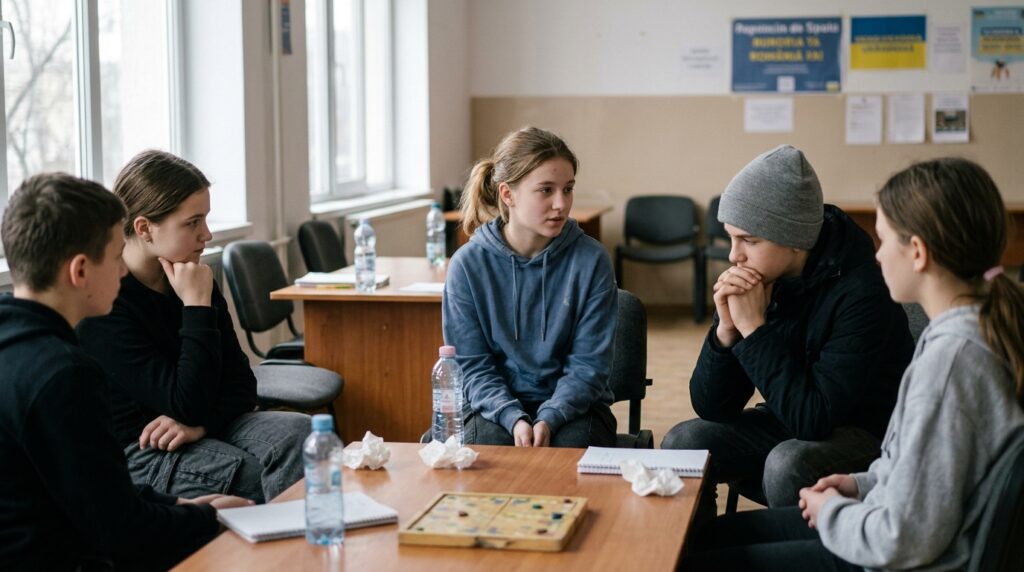
Adults often go to great lengths to shield youth from conversations about dying, yet confronting mortality openly may actually serve as a vital source of strength for young people facing crisis. A new study published in the journal Children & Society reveals that talking directly about death helps displaced Ukrainian adolescents cultivate resilience, deepen mutual support, and make sense of the overwhelming realities of war and forced displacement.
Breaking the Protective Silence Around Mortality
In contemporary Western societies, adults frequently maintain a protective silence around mortality, treating death as a taboo subject unsuitable for younger ears. However, recent global crises—most notably the COVID-19 pandemic and Russia’s full-scale invasion of Ukraine—have shattered this boundary, making death an immediate and unavoidable presence in children’s everyday lives.
According to researchers Adriana Teodorescu and Alina Bărbuță, displaced Ukrainian youths do not experience mortality as an abstract, distant biological event tied to old age. Instead, their lived experiences transform death into an urgent, violent, and politically charged intrusion that abruptly disrupts their families, communities, and sense of safety.
Open Dialogue Fosters Resilience, Not Fear
Caregivers and professionals often worry that discussing mortality will trigger acute anxiety or retraumatize vulnerable teenagers. Contrary to these assumptions, the study found that engaging adolescents in structured, honest conversations about loss does not intensify fear. Instead, open dialogue provides a much-needed outlet for young people to process complex emotional burdens, including survivor guilt and the moral conflict between enjoying personal safety abroad and demonstrating solidarity with those remaining in a war zone.
The researchers observed that articulating grief and confronting existential questions actively nurtured empathy and self-reflection. Far from isolating the participants, sharing these difficult reflections strengthened interpersonal bonds and emotional empowerment among peers navigating similar turmoil.
A Child-Centered Research Approach
To explore how displaced adolescents conceptualize loss, the authors implemented a qualitative, participatory design involving Ukrainian refugees aged 12 to 17 living in Romania. The research utilized focus groups, participant observation, and in-depth interviews.
Crucially, the adolescents were not treated merely as subjects, but actively participated in co-developing the interview guidelines. This collaborative approach ensured the discussions remained emotionally safe, culturally sensitive, and respectful of the teenagers’ agency. By recognizing young people as competent meaning-makers, the methodology allowed their authentic voices and perspectives to guide the inquiry.
The Case for Death Education in Schools
Based on their findings, the authors argue that genuine psychological protection is achieved through compassionate communication rather than institutional avoidance. When adults refuse to discuss mortality, young people are often left to process distressing realities alone without guidance or validation.
The researchers advocate for the integration of age-appropriate death education into schools and community learning environments. By opening communicative spaces where youth can openly explore finitude and trauma, educators and mental health practitioners can better support young refugees. Addressing death together, the authors conclude, transforms an otherwise isolating reality into a shared act of language, solidarity, and collective care.
Source
- ‘Do You Realise People Are Dying There?!’: Ukrainian Adolescents Reflecting on Death During Wartime
- Researchers: Adriana Teodorescu, Alina Bărbuță
- Journal: Children & Society
- Read the original study