
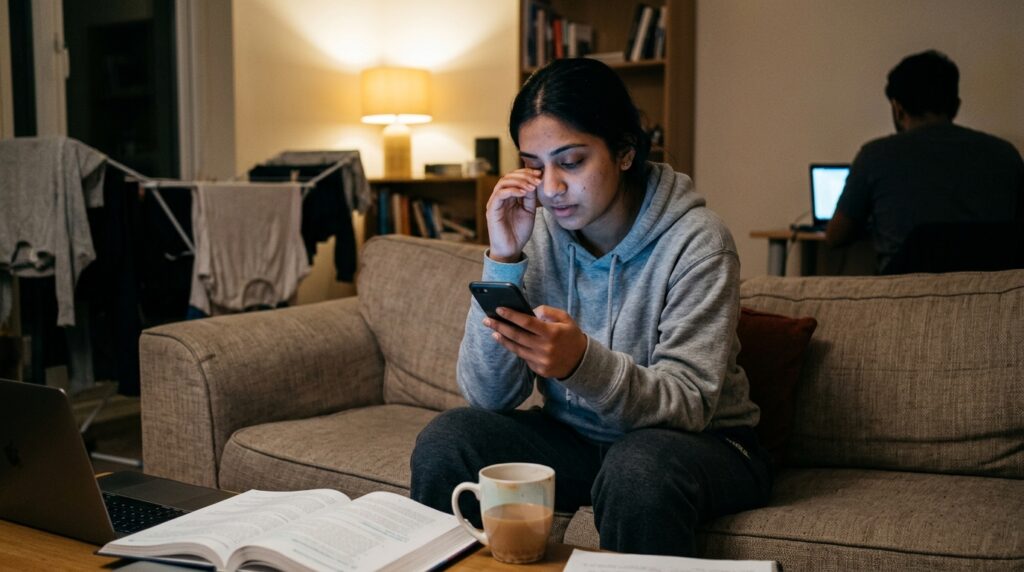
Young adults routinely spend hours glued to their smartphones, often while wrestling with restless nights and deteriorating mental well-being. Now, a comprehensive review synthesizes over a decade of research to help resolve an ongoing debate: it is not simply the total hours spent on a screen that damages rest, but rather when those hours occur. According to the study, published by Dr. Devendra Ramchandra Sathe, late-night screen exposure plays a far more decisive role in disrupting sleep and mood than daytime use.
Bedtime Scrolling Takes a Measurable Toll
College students and young adults now average between four and six hours of daily smartphone use, a habit that coincides with widespread complaints of poor sleep and psychological distress. To evaluate whether these trends are causally connected, the structured review examined observational surveys, meta-analyses, controlled laboratory experiments, and clinical trials published between 2015 and 2026.
The collected evidence confirmed notable links: problematic screen use was correlated with decreased sleep quality, increased risks of anxiety and depressive symptoms, and elevated suicidal ideation. However, the synthesis revealed that the raw total of daytime screen hours matters far less than previously assumed. Instead, the timing of device use exerts a substantially stronger influence on sleep outcomes and mental wellness.
The Biological Mechanism Behind the Screen Glow
Controlled laboratory trials highlighted in the study point to a clear biological culprit. Using light-emitting devices before bed disrupts sleep architecture via a direct photic pathway. Specifically, five consecutive evenings of pre-bedtime screen exposure delayed dim-light melatonin onset by more than 1.5 hours.
Melatonin acts as the primary chemical signal telling the body that night has arrived. By delaying this hormonal release, evening device use artificially resets the body’s internal circadian clock. Consequently, laboratory participants experienced lengthened sleep-onset latency, taking approximately 10 minutes longer to fall asleep compared to periods without evening screens.
Examining the Math: Duration vs. Impact
When researchers evaluated daily duration alone, the incremental risk of daytime screen time appeared relatively modest. The synthesis calculated that each additional daily hour of screen time raised the odds of poor sleep by just 4.2%. Even when comparing heavy use of eight hours per day against a light use of two hours, the excess odds of poor sleep totaled 28%.
Meta-analyses demonstrated that problematic screen habits carry elevated risk estimates for depression (3.17) and anxiety (3.50), though broader pooled correlation coefficients across studies remained modest, ranging between 0.28 and 0.36. The review also detected immense statistical variability among existing studies, with inconsistency metrics exceeding 94.7%. This high variability underscores that individual psychological vulnerability and specific engagement patterns differ significantly across users.
Why Short-Term Digital Detoxes Often Rebound
Efforts to tackle device overuse through drastic restrictions frequently backfire. In one randomized trial evaluated in the review, participants who restricted their screen time to two hours per day for three weeks achieved measurable improvements in mood and sleep, especially when they closely adhered to the rules.
Yet, these benefits proved temporary. Within two weeks of the restriction ending, participants’ usage returned entirely to baseline levels, demonstrating how difficult it is to sustain severe behavioral restrictions in an interconnected world. Rather than attempting extreme daytime bans or unsustainable digital detoxes, the findings suggest that individuals can protect their sleep and mental health far more effectively by establishing firm boundaries around bedtime scrolling.
Source
- SCREEN USE, SLEEP, AND MENTAL HEALTH PROBLEMS IN YOUNG ADULTS
- Researchers: Vaidya Dr. Devendra Ramchandra Sathe (PT) PhD.
- Journal: International Education and Research Journal
- Read the original study