
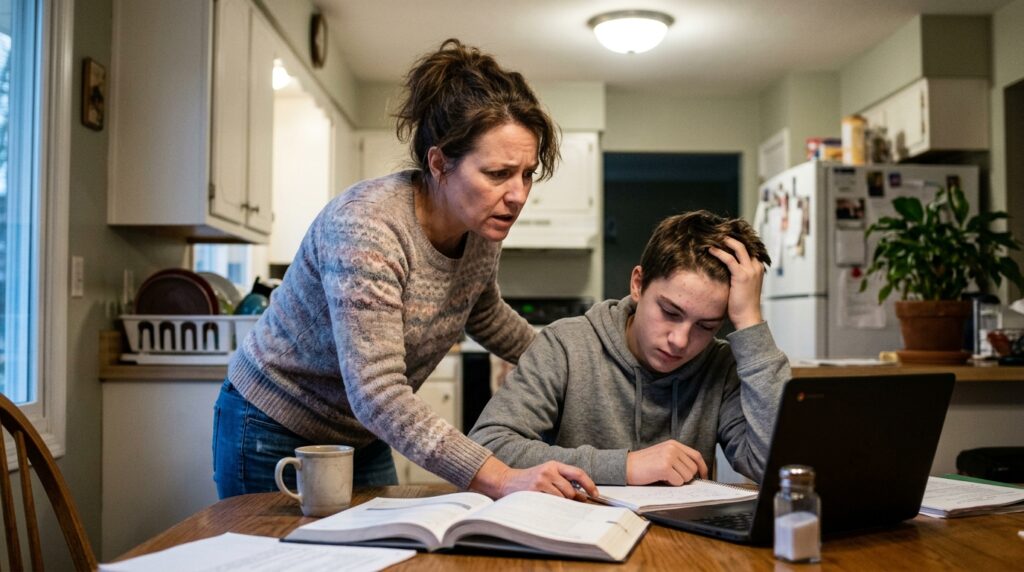
Popular culture often paints hyper-involved parents with a broad brush, portraying all protective behaviors as toxic meddling. However, a new study published in the Journal of Adolescence reveals that intense parental involvement is far from a monolith. By examining how teenagers perceive close guidance, researchers discovered that helicopter parenting actually encompasses two distinct dimensions that produce drastically divergent effects on adolescent well-being.
Unpacking the Complexity of Overparenting
Overprotective parenting has long been criticized for stunting independence and breeding anxiety. Yet, according to lead author Melanie J. Zimmer-Gembeck and her colleagues, these behaviors are much more nuanced than commonly believed. Rather than operating as a uniformly negative force, overparenting is divided into two distinct dimensions: demanding overparenting and responsive overparenting.
Demanding overparenting is characterized by coercive, intrusive control. In this style, parents aggressively oversee their teen’s daily life, infringe on personal boundaries, and impose their own desires without considering the adolescent’s viewpoint. Responsive overparenting, on the other hand, represents hands-on involvement offered as supportive guidance when adolescents confront complex decisions, academic challenges, or stressful life tasks.
Opposing Effects on Adolescent Well-Being
The psychological consequences of these two approaches could hardly be more different. Adolescents who reported experiencing high levels of demanding overparenting felt significantly less supported by their parents. This coercive control was also linked to heightened levels of psychological distress, indicating that micromanagement exacts a heavy mental health toll on young people.
In contrast, teenagers who experienced responsive overparenting reported stronger parental support and lower emotional distress. Rather than eroding their capabilities, responsive parental involvement was associated with enhanced decision-making skills and greater coping efficacy. When parental presence is framed as constructive aid rather than an intrusive mandate, it appears to bolster a teenager’s confidence in handling life’s difficulties.
How the Study Was Conducted
To evaluate these parenting styles from the perspective of youth, the researchers surveyed 512 Australian adolescents between 16 and 19 years old (comprising 34% boys, 64% girls, and 2% nonbinary youths). The study gathered direct self-reports on parental behaviors, perceived emotional support, distress levels, coping abilities, and decision-making styles, rather than relying exclusively on parents’ self-evaluations.
Using confirmatory factor analysis and partial correlations, the authors separated the two parenting dimensions. By statistically controlling for the shared variance between demanding and responsive behaviors, the researchers isolated the unique impact of each feature, confirming that they correlate in opposite directions with adolescent adjustment.
Key Takeaways for Families
The findings challenge the assumption that high parental involvement is inherently harmful. Instead, the study highlights that parental intention, delivery, and respect for adolescent autonomy make all the difference. Coercive intrusion undermines a teen’s emotional growth, but proactive responsiveness provides a reassuring safety net.
For parents navigating the teen years, the takeaway is clear: remaining available to provide guidance during difficult crossroads is beneficial, provided it does not cross into authoritarian control. Supporting adolescents as they learn to navigate their own decisions fosters the resilience and emotional stability essential for adulthood.
Source
- Adolescent Reports of Demanding and Responsive Features in Helicopter and Overprotective Parenting: Divergence of Correlations With Indicators of Adjustment
- Researchers: Melanie J. Zimmer‐Gembeck, Katherine M. Ryan, Bart Soenens, Grégoire Zimmermann, Stijn Van Petegem
- Journal: Journal of Adolescence
- Read the original study