
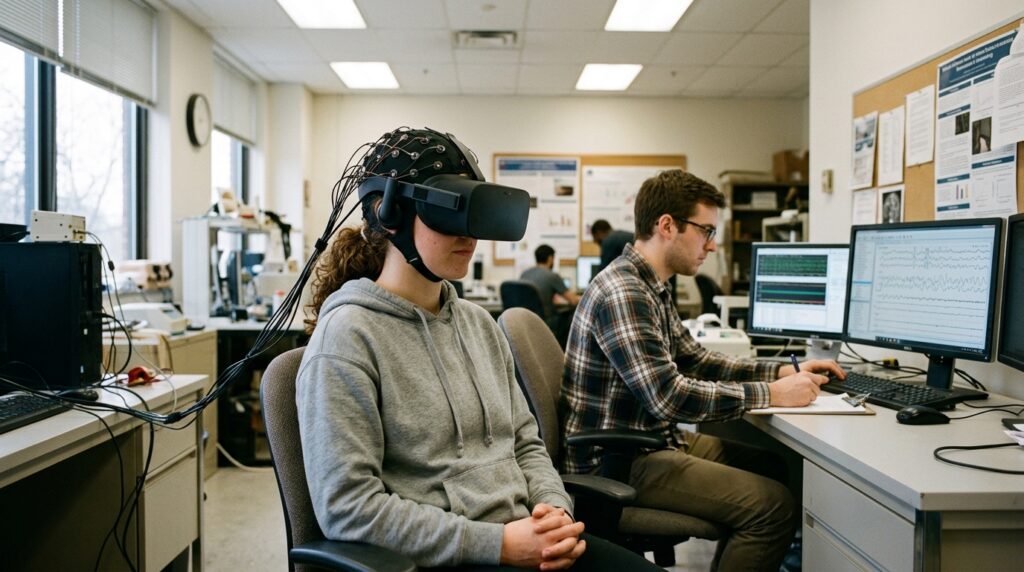
In an era of rising global anxiety, digital medicine may soon borrow tools from immersive gaming and computational neuroscience to help quiet the mind. A team of researchers at the Arab Academy for Science and Technology in Alexandria, Egypt, recently investigated whether interactive virtual reality (VR) exercises combined with wearable brain-monitoring tech could reliably track and alleviate mental stress. Their feasibility study, published in the journal Machine Learning and Knowledge Extraction, reveals both promising breakthroughs and critical nuances in the development of responsive mental healthcare tools.
A High-Tech Frontier for Stress Management
Chronic tension has emerged as a pervasive global health challenge, driving scientists to investigate accessible digital therapies that fit seamlessly into daily routines. To assess new possibilities, the study authors designed fully immersive VR attention-training games that engaged different facets of cognitive attention. Throughout these virtual experiences, participants were monitored using an electroencephalogram (EEG), a non-invasive tool that records electrical activity generated by the brain. By pairing structured virtual focus tasks with automated bio-signal monitoring, the researchers sought to evaluate whether gamified attention training could positively influence neural stress responses.
The Highly Personal Nature of Stress Signals
Deciphering brainwave signals required applying advanced machine learning algorithms to the recorded data. When the authors trained decision-tree classifiers tailored specifically to each individual user, the models accurately detected stress states with an impressive average accuracy of roughly 97%. However, when they attempted to deploy a generalized detector across multiple participants—using a leave-one-subject-out approach—accuracy dropped sharply to around 67%. According to the study, this notable discrepancy demonstrates that brain-based stress signatures vary tremendously from person to person, underscoring the necessity of personalized models over one-size-fits-all detection tools.
Did Virtual Reality Attention Games Ease Tension?
To determine whether the VR tasks genuinely calmed the brain, the team compared the prevalence of stress-associated EEG patterns before and after the training sessions. Under the personalized models, the researchers observed a statistically significant decline in classifier-predicted stress segments after participants completed the virtual exercises. However, the study authors emphasized a cautious interpretation of this change. Because this decline was not validated by the generalized, cross-subject detector or by geometric separation metrics, the authors characterized the outcome as an exploratory, model-predicted pattern rather than definitive, clinically verified stress reduction.
The Future of Smart, Responsive Mental Health Tools
Beyond its therapeutic implications, the investigation sets a high methodological bar for future artificial intelligence research in psychology. The authors made their complete dataset publicly accessible and implemented a strict, leakage-free testing procedure, splitting continuous time windows before segmenting data to ensure the models were not artificially inflated by overlapping information. While translating neuroadaptive VR games into everyday clinical treatment remains an ongoing effort, the study demonstrates how combining wearable sensors with individualized algorithms can lay the groundwork for intelligent, real-time stress management tools.
Source
- Exploring EEG-Guided Virtual Reality-Based Attention Training for Stress Detection and Reduction: A Machine Learning Approach
- Researchers: Rojaina Mahmoud, Omneya Attallah, Ahmad Al-Kabbany
- Journal: Machine Learning and Knowledge Extraction
- Read the original study