
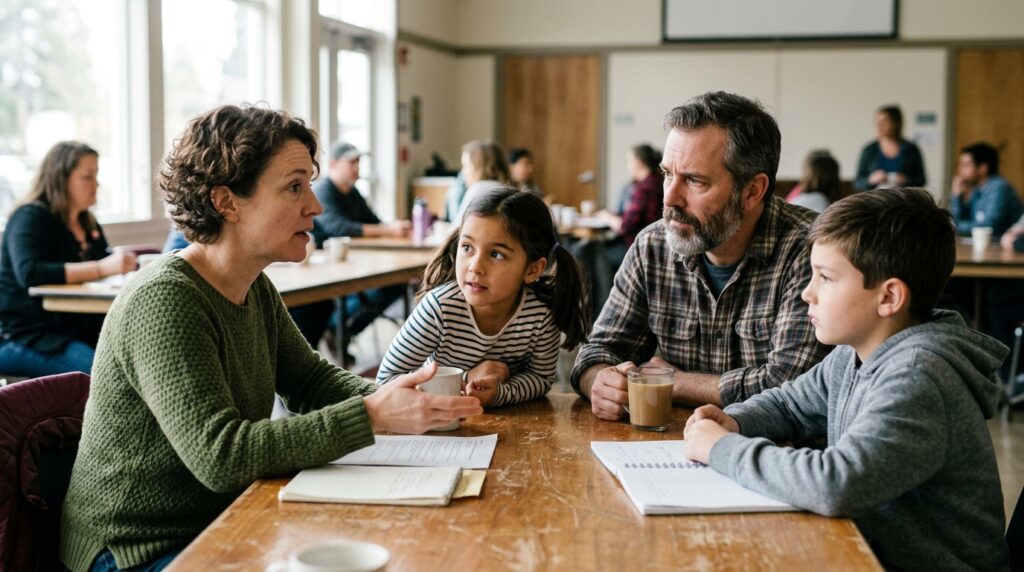
Human beings instinctively shy away from people who challenge their opinions, creating intellectual blind spots at school, in the workplace, and in everyday life. But according to a new study published in the journal Developmental Science, this tendency is far from unchangeable. Researchers Kirsten H. Blakey and Samuel Ronfard discovered that while both children and adults routinely dodge dissenting voices, two straightforward mental reframing techniques can significantly increase their willingness to engage with and learn from opposing viewpoints.
The Double Standard in Seeking Opposing Views
Across four preregistered experiments involving children aged 6 to 11 and adults from Canada and the United States, the researchers documented a clear pattern of selective exposure. When given the choice to discover information from an informant who agreed with their current beliefs or someone who held a conflicting perspective, both age groups consistently gravitated toward those who affirmed their existing views.
However, an intriguing contradiction emerged when participants were prompted to give advice. When asked what another person should do to learn as much as possible, children aged 7 to 11 and adults overwhelmingly recommended seeking out disagreement. This pronounced “self-other gap” revealed that people grasp the educational merit of clashing opinions in principle, even as they actively avoid that tension in their own personal choices.
Two Strategies That Nudge People Toward Disagreement
To overcome this double standard, the researchers tested two simple interventions. In the first, they directly taught participants about the intellectual benefits of hearing differing viewpoints. This brief educational intervention successfully reduced agreement-seeking behavior, showing particularly strong results among older children and adult participants who subsequently chose to explore alternative perspectives.
The second intervention took an even simpler behavioral approach. Before deciding whom to learn from, participants were asked to reflect on what someone else should do in that scenario. Just taking a moment to contemplate advice for another person significantly nudged participants to practice what they preached, noticeably increasing their willingness to engage with dissenting viewpoints.
Why Stepping Back Encourages Open-Mindedness
The effectiveness of this advice-giving prompt hinges on a psychological mechanism known as self-distancing. Engaging in third-person reflection allowed adults and older children aged 10 to 11 to mentally step back from the social anxiety or discomfort associated with conflicting views, helping them bypass a defensive cognitive bias that favors conformity.
By shifting perspectives, individuals were able to prioritize long-term epistemic benefits—the pursuit of truth and deeper understanding—over the immediate social friction of a debate. According to the study, this proves that retreating from opposing voices does not stem from an inability to understand the value of debate, but rather from a default mindset that can be redirected with light-touch framing.
Practical Lessons for Classrooms and Everyday Conversations
These findings hold tangible value for schools, homes, and public discourse. Because avoiding disagreement shuts down critical avenues for intellectual development, the researchers emphasize that parents and teachers should explicitly instruct children on the merits of debate rather than assuming open-mindedness will naturally flourish on its own.
Moreover, adopting a simple mental habit—asking oneself, “What would I recommend a friend do to learn the most?”—serves as an accessible tool to pierce modern echo chambers. By reframing divergent opinions as educational assets rather than threats, learners of all ages can cultivate genuine intellectual curiosity.
Source
- How to Increase Children's and Adults’ Interest in Learning From Disagreement
- Researchers: Kirsten H. Blakey, Samuel Ronfard
- Journal: Developmental Science
- Read the original study